PrepZillaPrepZilla
Dashboard
Learn
Part A (Aptitude)Part B (Drawing)
Practice
Test SimulationDaily DrillsPYQsAnalytics
Library
FlashcardsClassic PuzzlesTypography LabExam PatternsGalleryBookmarks
Privacy·Terms·
⌘B
Dashboard
Part A
Part B
Tests

Classic Puzzles

35

Untimed geometry, graph, and spatial challenges from H. E. Dudeney (1917).

0 / 35 solved
/
Showing all 35 puzzlesAdapted from H. E. Dudeney, Amusements in Mathematics (1917)
Diagram for Mrs. Hobson's Hearthrug
#154·NAT
Medium

Mrs. Hobson's Hearthrug

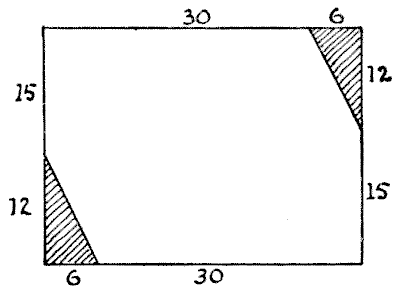
Mrs. Hobson's boy had an accident when playing with the fire, and burnt two of the corners of a pretty hearthrug. The damaged corners have been cut away, and it now has the appearance and proportions shown in my diagram. How is Mrs. Hobson to cut the rug into the fewest possible pieces that will fit together and form a perfectly square rug? It will be seen that the rug is in the proportions 36 × 27 (it does not matter whether we say inches or yards), and each piece cut away measured 12 and 6 on the outside. Question: What is the side length (in the same units) of the resulting square rug?
Solve
Diagram for St. George's Banner
#185·NAT
Easy

St. George's Banner

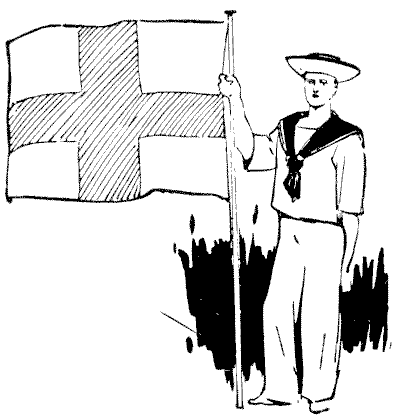
At a celebration of the national festival of St. George's Day I was contemplating the familiar banner of the patron saint of our country. We all know the red cross on a white ground, shown in our illustration. This is the banner of St. George. The banner of St. Andrew (Scotland) is a white "St. Andrew's Cross" on a blue ground. That of St. Patrick (Ireland) is a similar cross in red on a white ground. These three are united in one to form our Union Jack. Now on looking at St. George's banner it occurred to me that the following question would make a simple but pretty little puzzle. Supposing the flag measures four feet by three feet, how wide must the arm of the cross be if it is required that there shall be used just the same quantity of red and of white bunting? Enter the width of the arm in feet.

Solve
Diagram for The Yorkshire Estates
#189·NAT
Medium

The Yorkshire Estates

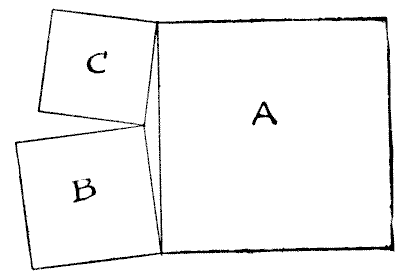
I was on a visit to one of the large towns of Yorkshire. While walking to the railway station on the day of my departure a man thrust a hand-bill upon me, and I took this into the railway carriage and read it at my leisure. It informed me that three Yorkshire neighbouring estates were to be offered for sale. Each estate was square in shape, and they joined one another at their corners, just as shown in the diagram. Estate A contains exactly 370 acres, B contains 116 acres, and C 74 acres. Now, the little triangular bit of land enclosed by the three square estates was not offered for sale, and, for no reason in particular, I became curious as to the area of that piece. How many acres did it contain? Enter the area in acres.

Solve
Diagram for Farmer Wurzel's Estate
#190·NAT
Hard

Farmer Wurzel's Estate

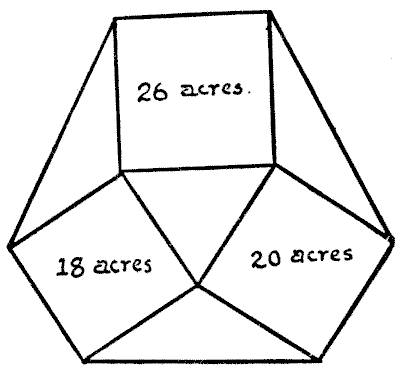
I will now present another land problem. The demonstration of the answer that I shall give will, I think, be found both interesting and easy of comprehension. Farmer Wurzel owned the three square fields shown in the annexed plan, containing respectively 18, 20, and 26 acres. In order to get a ring-fence round his property he bought the four intervening triangular fields. The puzzle is to discover what was then the whole area of his estate. Enter the total area in acres.

Solve
Diagram for The Crescent Puzzle
#191·NAT
Medium

The Crescent Puzzle

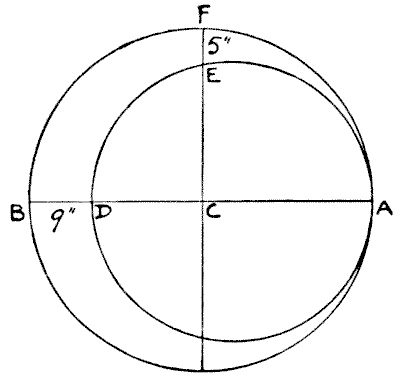
Here is an easy geometrical puzzle. The crescent is formed by two circles, and C is the centre of the larger circle. The width of the crescent between B and D is 9 inches, and between E and F 5 inches. What are the diameters of the two circles? Enter the diameter of the larger circle in inches.

Solve
Diagram for How to Make Cisterns
#201·NAT
Medium

How to Make Cisterns

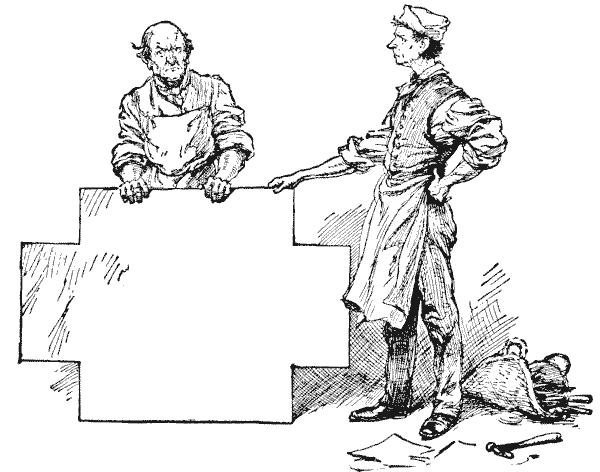
Our friend in the illustration has a large sheet of zinc, measuring (before cutting) eight feet by three feet, and he has cut out square pieces (all of the same size) from the four corners and now proposes to fold up the sides, solder the edges, and make a cistern. But the point that puzzles him is this: Has he cut out those square pieces of the correct size in order that the cistern may hold the greatest possible quantity of water? You see, if you cut them very small you get a very shallow cistern; if you cut them large you get a tall and slender one. It is all a question of finding a way of cutting out these four square pieces exactly the right size. How are we to avoid making them too small or too large? Enter the side length (in inches) of each corner square to maximize the cistern's volume.

Solve
Diagram for The Cone Puzzle
#202·MCQ
Medium

The Cone Puzzle

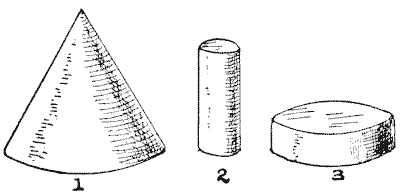
I have a wooden cone, as shown in Fig. 1. How am I to cut out of it the greatest possible cylinder? It will be seen that I can cut out one that is long and slender, like Fig. 2, or short and thick, like Fig. 3. But neither is the largest possible. A child could tell you where to cut, if he knew the rule. Can you find this simple rule? Where should the horizontal cut be made to maximize the cylinder's volume?

Solve
Dudeney #178 · MSQ

This puzzle is not difficult, but it will be found entertaining to discover the simple rule for its solution. I have a rectangular cardboard box. The top has an area of 120 square inches, the side 96 square inches, and the end 80 square inches. What are the exact dimensions of the box? Select all statements below that are true about this cardboard box.

#178·MSQ
Medium

The Cardboard Box

Solve
Dudeney #179 · NAT

Two men broke into a church tower one night to steal the bell-ropes. The two ropes passed through holes in the wooden ceiling high above them, and they lost no time in climbing to the top. Then one man drew his knife and cut the rope above his head, in consequence of which he fell to the floor and was badly injured. His fellow-thief called out that it served him right for being such a fool. He said that he should have done as he was doing, upon which he cut the rope below the place at which he held on. Then, to his dismay, he found that he was in no better plight, for, after hanging on as long as his strength lasted, he was compelled to let go and fall beside his comrade. Here they were both found the next morning with their limbs broken. How far did they fall? One of the ropes when they found it was just touching the floor, and when you pulled the end to the wall, keeping the rope taut, it touched a point just three inches above the floor, and the wall was four feet from the rope when it hung at rest. How long was the rope from floor to ceiling? Enter the total length of the rope from floor to ceiling in inches (as a decimal).

#179·NAT
Medium

Stealing the Bell-Ropes

Solve
Dudeney #181 · NAT

As I sat in a railway carriage I noticed at the other end of the compartment a worthy squire, whom I knew by sight, engaged in conversation with another passenger, who was evidently a friend of his. "How far have you to drive to your place from the railway station?" asked the stranger. "Well," replied the squire, "if I get out at Appleford, it is just the same distance as if I go to Bridgefield, another fifteen miles farther on; and if I changed at Appleford and went thirteen miles from there to Carterton, it would still be the same distance. You see, I am equidistant from the three stations, so I get a good choice of trains." Now I happened to know that Bridgefield is just fourteen miles from Carterton, so I amused myself in working out the exact distance that the squire had to drive home whichever station he got out at. What was the distance? Enter the distance in miles as an exact decimal.

#181·NAT
Hard

The Three Railway Stations

Solve
Dudeney #182 · NAT

Professor Rackbrain tells me that he was recently smoking a friendly pipe under a tree in the garden of a country acquaintance. The garden was enclosed by four straight walls, and his friend informed him that he had measured these and found the lengths to be 80, 45, 100, and 63 yards respectively. "Then," said the professor, "we can calculate the exact area of the garden." "Impossible," his host replied, "because you can get an infinite number of different shapes with those four sides." "But you forget," Rackbrane said, with a twinkle in his eye, "that you told me once you had planted this tree equidistant from all the four corners of the garden." Can you work out the garden's area? Enter the area in square yards.

#182·NAT
Hard

The Garden Puzzle

Solve
Dudeney #186 · MCQ

A boy tied a clothes line from the top of each of two poles to the base of the other. He then proposed to his father the following question. As one pole was exactly seven feet above the ground and the other exactly five feet, what was the height from the ground where the two cords crossed one another? What was the height from the ground where the two cords crossed one another?

#186·MCQ
Medium

The Clothes Line Puzzle

Solve
Diagram for The Ball Problem
#188·MSQ
Medium

The Ball Problem

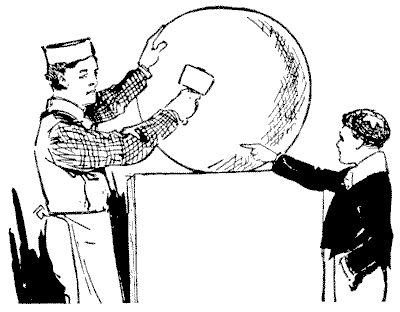
A stonemason was engaged the other day in cutting out a round ball for the purpose of some architectural decoration, when a smart schoolboy came upon the scene. "Look here," said the mason, "you seem to be a sharp youngster, can you tell me this? If I placed this ball on the level ground, how many other balls of the same size could I lay around it (also on the ground) so that every ball should touch this one?" The boy at once gave the correct answer, and then put this little question to the mason:— "If the surface of that ball contained just as many square feet as its volume contained cubic feet, what would be the length of its diameter?" The stonemason could not give an answer. Could you have replied correctly to the mason's and the boy's questions? Select all statements below that correctly answer the mason's and the boy's questions.

Solve
Diagram for The Potato Puzzle
#164·NAT
Easy

The Potato Puzzle

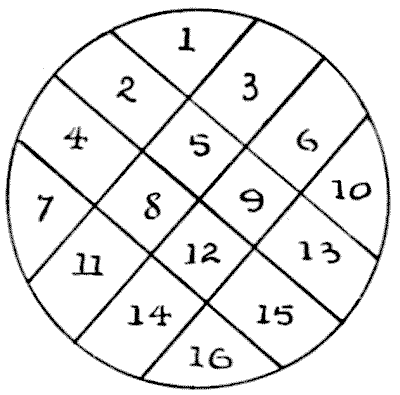
Take a circular slice of potato, place it on the table, and see into how large a number of pieces you can divide it with six cuts of a knife. Of course you must not readjust the pieces or pile them after a cut. What is the greatest number of pieces you can make? The illustration shows how to make sixteen pieces. This can, of course, be easily beaten.

Solve
Diagram for The Landowner's Fences
#166·NAT
Medium

The Landowner's Fences

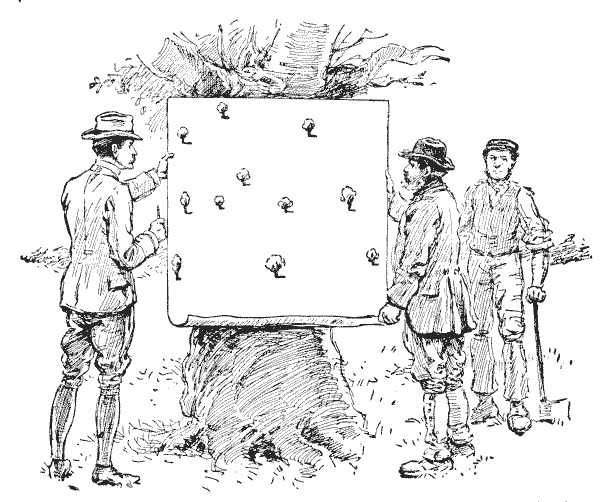
The landowner in the illustration is consulting with his bailiff over a rather puzzling little question. He has a large plan of one of his fields, in which there are eleven trees. Now, he wants to divide the field into just eleven enclosures by means of straight fences, so that every enclosure shall contain one tree as a shelter for his cattle. How is he to do it with as few fences as possible? Take your pencil and draw straight lines across the field until you have marked off the eleven enclosures (and no more), and then see how many fences you require. Of course the fences may cross one another. Enter the minimum number of straight fences required.

Solve
Diagram for Mrs. Perkins's Quilt
#173·NAT
Hard

Mrs. Perkins's Quilt

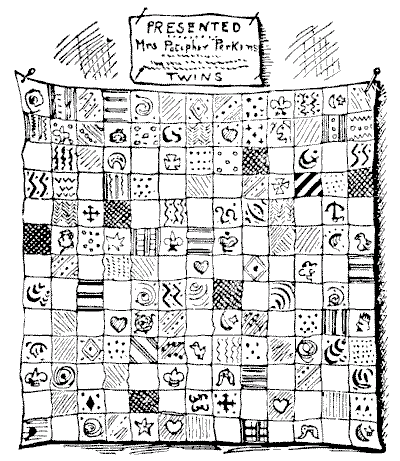
It will be seen that in this case the square patchwork quilt is built up of 169 pieces. The puzzle is to find the smallest possible number of square portions of which the quilt could be composed and show how they might be joined together. Or, to put it the reverse way, divide the quilt into as few square portions as possible by merely cutting the stitches. Enter the smallest possible number of separate square portions (each smaller than the whole 13 x 13 quilt).

Solve
Diagram for The Square of Veneer
#159·MCQ
Hard

The Square of Veneer

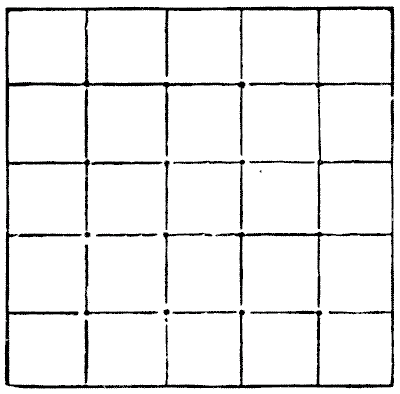
The following represents a piece of wood in my possession, 5 in. square. By markings on the surface it is divided into twenty-five square inches. I want to discover a way of cutting this piece of wood into the fewest possible pieces that will fit together and form two perfect squares of different sizes and of known dimensions. But, unfortunately, at every one of the sixteen intersections of the cross lines a small nail has been driven in at some time or other, and my fret-saw will be injured if it comes in contact with any of these. I have therefore to find a method of doing the work that will not necessitate my cutting through any of those sixteen points. How is it to be done? Remember, the exact dimensions of the two squares must be given. What are the exact dimensions (side lengths) of the two squares formed?

Solve
Diagram for The Four Postage Stamps
#285·NAT
Medium

The Four Postage Stamps

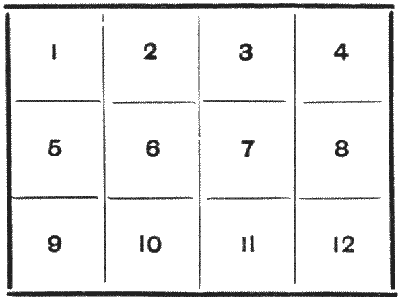
"It is as easy as counting," is an expression one sometimes hears. But mere counting may be puzzling at times. Take the following simple example. Suppose you have just bought twelve postage stamps, in this form—three by four—and a friend asks you to oblige him with four stamps, all joined together—no stamp hanging on by a mere corner. In how many different ways is it possible for you to tear off those four stamps? You see, you can give him 1, 2, 3, 4, or 2, 3, 6, 7, or 1, 2, 3, 6, or 1, 2, 3, 7, or 2, 3, 4, 8, and so on. Can you count the number of different ways in which those four stamps might be delivered? There are not many more than fifty ways, so it is not a big count. Can you get the exact number?

Solve
Diagram for The Barrels of Balsam
#279·NAT
Hard

The Barrels of Balsam

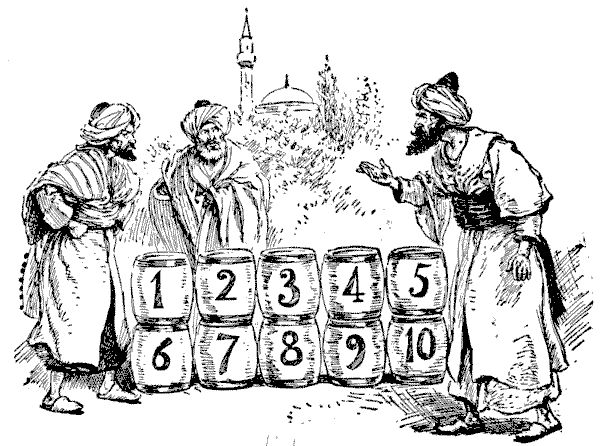
A merchant of Bagdad had ten barrels of precious balsam for sale. They were numbered, and were arranged in two rows, one on top of the other, as shown in the picture. The smaller the number on the barrel, the greater was its value. So that the best quality was numbered "1" and the worst numbered "10," and all the other numbers of graduating values. Now, the rule of Ahmed Assan, the merchant, was that he never put a barrel either beneath or to the right of one of less value. The arrangement shown is, of course, the simplest way of complying with this condition. But there are many other ways—such, for example, as this:— 1 2 5 7 8 3 4 6 9 10 Here, again, no barrel has a smaller number than itself on its right or beneath it. The puzzle is to discover in how many different ways the merchant of Bagdad might have arranged his barrels in the two rows without breaking his rule. Can you count the number of ways?

Solve
Diagram for The Cross Target
#284·NAT
Medium

The Cross Target

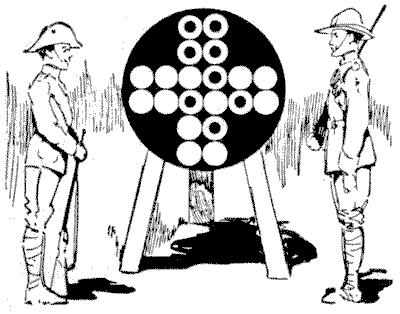
In the illustration we have a somewhat curious target designed by an eccentric sharpshooter. His idea was that in order to score you must hit four circles in as many shots so that those four shots shall form a square. It will be seen by the results recorded on the target that two attempts have been successful. The first man hit the four circles at the top of the cross, and thus formed his square. The second man intended to hit the four in the bottom arm, but his second shot, on the left, went too high. This compelled him to complete his four in a different way than he intended. It will thus be seen that though it is immaterial which circle you hit at the first shot, the second shot may commit you to a definite procedure if you are to get your square. Now, the puzzle is to say in just how many different ways it is possible to form a square on the target with four shots.

Solve
Diagram for The Level Puzzle
#255·NAT
Easy

The Level Puzzle

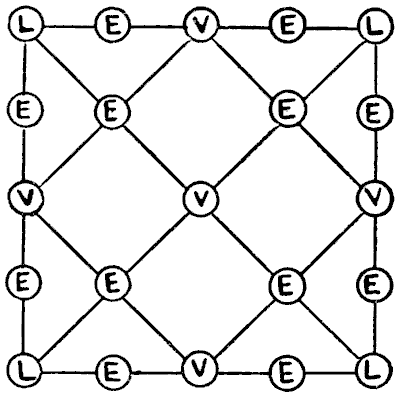
This is a simple counting puzzle. In how many different ways can you spell out the word LEVEL by placing the point of your pencil on an L and then passing along the lines from letter to letter. You may go in any direction, backwards or forwards. Of course you are not allowed to miss letters—that is to say, if you come to a letter you must use it.

Solve
Diagram for The Diamond Puzzle
#256·NAT
Medium

The Diamond Puzzle

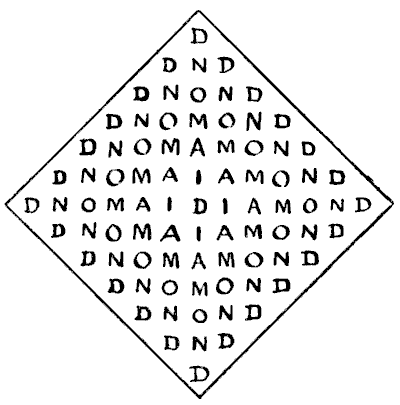
IN how many different ways may the word DIAMOND be read in the arrangement shown? You may start wherever you like at a D and go up or down, backwards or forwards, in and out, in any direction you like, so long as you always pass from one letter to another that adjoins it. How many ways are there? Note: Pass only between horizontally or vertically adjoining letters (no diagonal steps).

Solve
Diagram for A Bank Holiday Puzzle
#253·MCQ
Medium

A Bank Holiday Puzzle

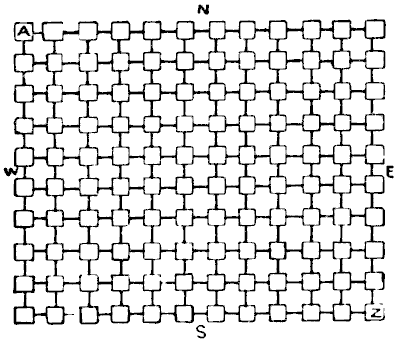
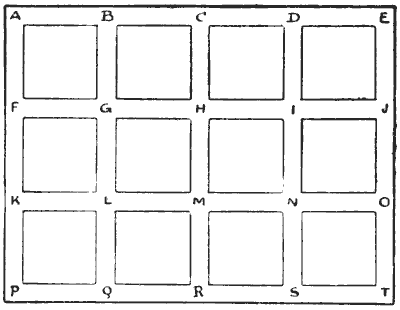
Two friends were spending their bank holiday on a cycling trip. Stopping for a rest at a village inn, they consulted a route map, which is represented in our illustration in an exceedingly simplified form, for the puzzle is interesting enough without all the original complexities. They started from the town in the top left-hand corner marked A. It will be seen that there are one hundred and twenty such towns, all connected by straight roads. Now they discovered that there are exactly 1,365 different routes by which they may reach their destination, always travelling either due south or due east. The puzzle is to discover which town is their destination. Of course, if you find that there are more than 1,365 different routes to a town it cannot be the right one. Which town is their destination?

Solve
Diagram for The Union Jack
#240·MSQ
Hard

The Union Jack

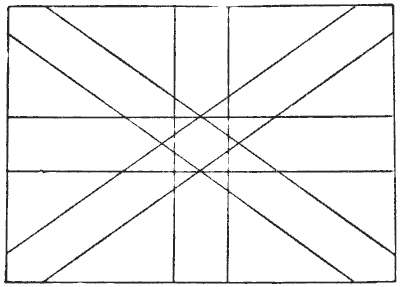
The illustration is a rough sketch somewhat resembling the British flag, the Union Jack. It is not possible to draw the whole of it without lifting the pencil from the paper or going over the same line twice. The puzzle is to find out just how much of the drawing it is possible to make without lifting your pencil or going twice over the same line. Take your pencil and see what is the best you can do. Select all statements below that are true about drawing this figure without lifting your pencil or going twice over any line.

Solve
Diagram for The Tube Inspector's Puzzle
#242·NAT
Medium

The Tube Inspector's Puzzle

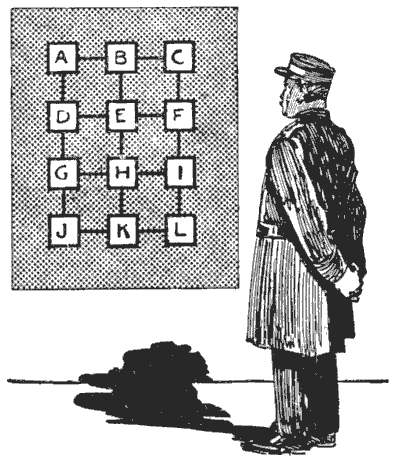
The man in our illustration is in a little dilemma. He has just been appointed inspector of a certain system of tube railways, and it is his duty to inspect regularly, within a stated period, all the company's seventeen lines connecting twelve stations, as shown on the big poster plan that he is contemplating. Now he wants to arrange his route so that it shall take him over all the lines with as little travelling as possible. He may begin where he likes and end where he likes. What is his shortest route? Could anything be simpler? But the reader will soon find that, however he decides to proceed, the inspector must go over some of the lines more than once. In other words, if we say that the stations are a mile apart, he will have to travel more than seventeen miles to inspect every line. There is the little difficulty. How far is he compelled to travel, and which route do you recommend? Enter the shortest total distance in miles.

Solve
Diagram for Inspecting a Mine
#247·NAT
Hard

Inspecting a Mine

The diagram is supposed to represent the passages or galleries in a mine. We will assume that every passage, A to B, B to C, C to H, H to I, and so on, is one furlong in length. It will be seen that there are thirty-one of these passages. Now, an official has to inspect all of them, and he descends by the shaft to the point A. How far must he travel, and what route do you recommend? The reader may at first say, "As there are thirty-one passages, each a furlong in length, he will have to travel just thirty-one furlongs." But this is assuming that he need never go along a passage more than once, which is not the case. Take your pencil and try to find the shortest route. You will soon discover that there is room for considerable judgment. In fact, it is a perplexing puzzle. Enter the shortest total distance in furlongs.

Solve
Diagram for The Icosahedron Puzzle
#246·NAT
Hard

The Icosahedron Puzzle

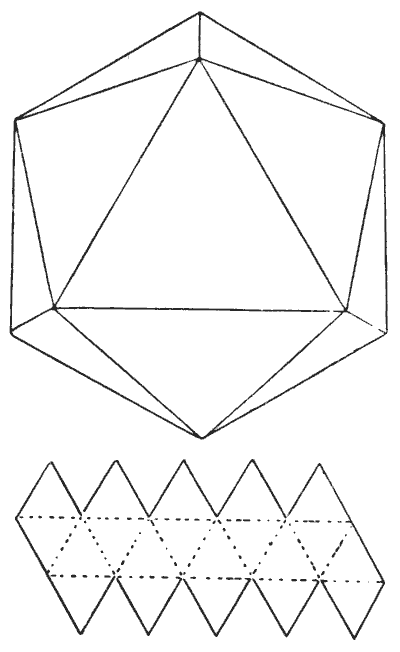
The icosahedron is another of the five regular, or Platonic, bodies having all their sides, angles, and planes similar and equal. It is bounded by twenty similar equilateral triangles. If you cut out a piece of cardboard of the form shown in the smaller diagram, and cut half through along the dotted lines, it will fold up and form a perfect icosahedron. Now, a Platonic body does not mean a heavenly body; but it will suit the purpose of our puzzle if we suppose there to be a habitable planet of this shape. We will also suppose that, owing to a superfluity of water, the only dry land is along the edges, and that the inhabitants have no knowledge of navigation. If every one of those edges is 10,000 miles long and a solitary traveller is placed at the North Pole (the highest point shown), how far will he have to travel before he will have visited every habitable part of the planet—that is, have traversed every one of the edges? Enter the minimum total distance in miles.

Solve
Diagram for The Monk and the Bridges
#261·NAT
Medium

The Monk and the Bridges

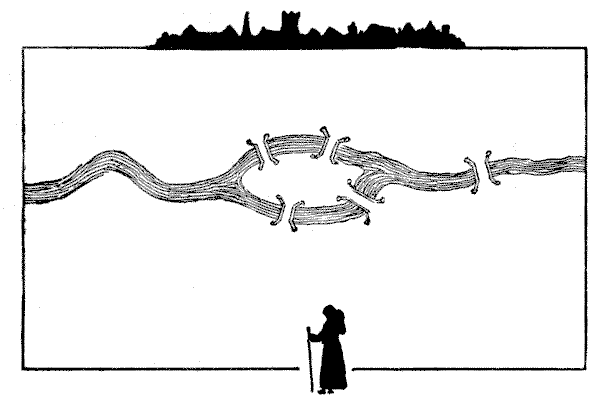
In this case I give a rough plan of a river with an island and five bridges. On one side of the river is a monastery, and on the other side is seen a monk in the foreground. Now, the monk has decided that he will cross every bridge once, and only once, on his return to the monastery. This is, of course, quite easy to do, but on the way he thought to himself, "I wonder how many different routes there are from which I might have selected." Could you have told him? That is the puzzle. Take your pencil and trace out a route that will take you once over all the five bridges. Then trace out a second route, then a third, and see if you can count all the variations. You will find that the difficulty is twofold: you have to avoid dropping routes on the one hand and counting the same routes more than once on the other.

Solve
Diagram for The Six Frogs
#214·NAT
Medium

The Six Frogs

The six educated frogs in the illustration are trained to reverse their order, so that their numbers shall read 6, 5, 4, 3, 2, 1, with the blank square in its present position. They can jump to the next square (if vacant) or leap over one frog to the next square beyond (if vacant), just as we move in the game of draughts, and can go backwards or forwards at pleasure. Can you show how they perform their feat in the fewest possible moves? It is quite easy, so when you have done it add a seventh frog to the right and try again. Then add more frogs until you are able to give the shortest solution for any number. For it can always be done, with that single vacant square, no matter how many frogs there are. Enter the fewest possible number of moves for the six frogs.

Solve
Diagram for The Letter Block Puzzle
#219·NAT
Hard

The Letter Block Puzzle

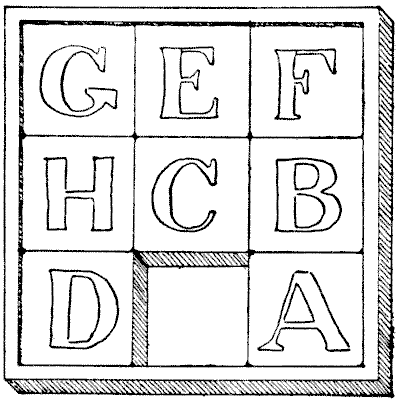
Here is a little reminiscence of our old friend the Fifteen Block Puzzle. Eight wooden blocks are lettered, and are placed in a box, as shown in the illustration. It will be seen that you can only move one block at a time to the place vacant for the time being, as no block may be lifted out of the box. The puzzle is to shift them about until you get them in the order— A B C D E F G H This you will find by no means difficult if you are allowed as many moves as you like. But the puzzle is to do it in the fewest possible moves. I will not say what this smallest number of moves is, because the reader may like to discover it for himself. In writing down your moves you will find it necessary to record no more than the letters in the order that they are shifted. Thus, your first five moves might be C, H, G, E, F; and this notation can have no possible ambiguity. In practice you only need eight counters and a simple diagram on a sheet of paper. Enter the fewest possible number of moves.

Solve
Diagram for The Barrel of Beer
#76·MSQ
Medium

The Barrel of Beer

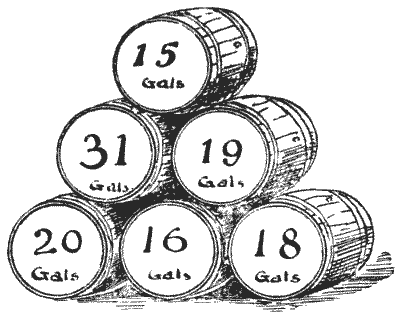
A man bought an odd lot of wine in barrels and one barrel containing beer. These are shown in the illustration, marked with the number of gallons that each barrel contained. He sold a quantity of the wine to one man and twice the quantity to another, but kept the beer to himself. The puzzle is to point out which barrel contains beer. Can you say which one it is? Of course, the man sold the barrels just as he bought them, without manipulating in any way the contents. Select all statements below that must be true.

Solve
Diagram for Concerning Wheels
#203·NAT
Medium

Concerning Wheels

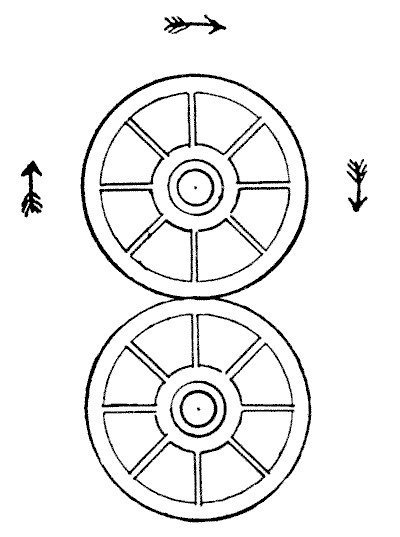
There are some curious facts concerning the movements of wheels that are apt to perplex the novice. For example: when a railway train is travelling from London to Crewe certain parts of the train at any given moment are actually moving from Crewe towards London. Can you indicate those parts? It seems absurd that parts of the same train can at any time travel in opposite directions, but such is the case. In the accompanying illustration we have two wheels. The lower one is supposed to be fixed and the upper one running round it in the direction of the arrows. Now, how many times does the upper wheel turn on its own axis in making a complete revolution of the other wheel? Do not be in a hurry with your answer, or you are almost certain to be wrong. Experiment with two pennies on the table and the correct answer will surprise you, when you succeed in seeing it. For the two wheels shown in the illustration, enter the number of times the upper wheel turns on its own axis in making one complete revolution around the fixed lower wheel.

Solve
Diagram for Painting a Pyramid
#281·NAT
Hard

Painting a Pyramid

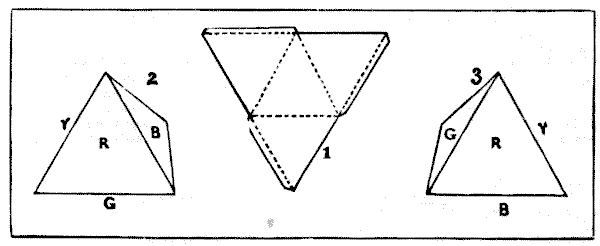
This puzzle concerns the painting of the four sides of a tetrahedron, or triangular pyramid. If you cut out a piece of cardboard of the triangular shape shown in Fig. 1, and then cut half through along the dotted lines, it will fold up and form a perfect triangular pyramid. And I would first remind my readers that the primary colours of the solar spectrum are seven—violet, indigo, blue, green, yellow, orange, and red. When I was a child I was taught to remember these by the ungainly word formed by the initials of the colours, "Vibgyor." In how many different ways may the triangular pyramid be coloured, using in every case one, two, three, or four colours of the solar spectrum? Of course a side can only receive a single colour, and no side can be left uncoloured. But there is one point that I must make quite clear. The four sides are not to be regarded as individually distinct. That is to say, if you paint your pyramid as shown in Fig. 2 (where the bottom side is green and the other side that is out of view is yellow), and then paint another in the order shown in Fig. 3, these are really both the same and count as one way. For if you tilt over No. 2 to the right it will so fall as to represent No. 3. The avoidance of repetitions of this kind is the real puzzle of the thing. If a coloured pyramid cannot be placed so that it exactly resembles in its colours and their relative order another pyramid, then they are different. Remember that one way would be to colour all the four sides red, another to colour two sides green, and the remaining sides yellow and blue; and so on.

Solve
Diagram for The Dovetailed Block
#424·MCQ
Medium

The Dovetailed Block

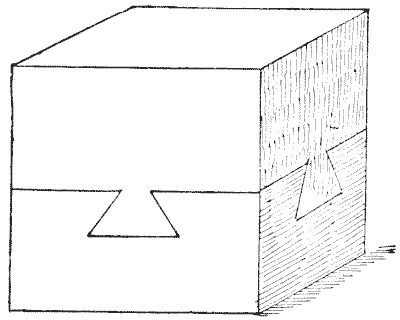
Here is a curious mechanical puzzle that was given to me some years ago, but I cannot say who first invented it. It consists of two solid blocks of wood securely dovetailed together. On the other two vertical sides that are not visible the appearance is precisely the same as on those shown. How were the pieces put together? When I published this little puzzle in a London newspaper I received (though they were unsolicited) quite a stack of models, in oak, in teak, in mahogany, rosewood, satinwood, elm, and deal; some half a foot in length, and others varying in size right down to a delicate little model about half an inch square. It seemed to create considerable interest. How were the two solid blocks put together (or slid apart)?

Solve
Diagram for The Industrious Bookworm
#420·MCQ
Easy

The Industrious Bookworm

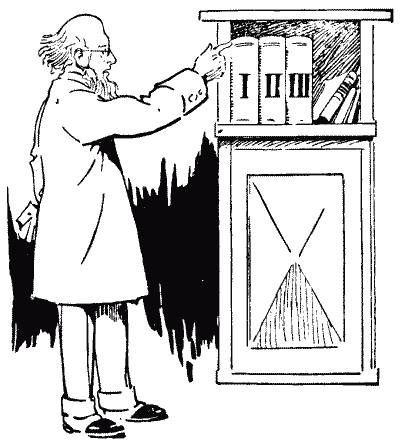
Our friend Professor Rackbrane is seen in the illustration to be propounding another of his little posers. He is explaining that since he last had occasion to take down those three volumes of a learned book from their place on his shelves a bookworm has actually bored a hole straight through from the first page to the last. He says that the leaves are together three inches thick in each volume, and that every cover is exactly one-eighth of an inch thick, and he asks how long a tunnel had the industrious worm to bore in preparing his new tube railway. Can you tell him? How long a tunnel did the bookworm bore in inches?

Solve